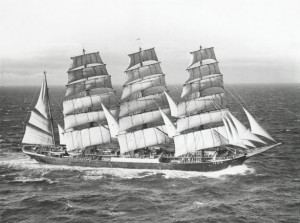
 was the informal name for the annual windjammer sailing season generally from South Australia’s grain ports on Spencer Gulf to Lizard Point, Cornwall on the southwesternmost coast of the United Kingdom, or to specific ports. A good, fast passage Australia-to-England via Cape Horn was considered anything under 100 days…’ link
(Pictured is the Pamir at the entrance to the English Channel)
I remember as a kid seeing the names of the great sailing ships still visible on the sides of the long wharf at Wallaroo, painted there by the crews.
CrusaderRabbit
FOR LIBERTY

The crew must have has it tough especially in the Southern Ocean. Have you read Dana’s Two Years Before the Mast?
I sure have. That degree of hardship is almost unimaginable nowadays.
How about this.
http://www.telegraph.co.uk/sport/othersports/sailing/11248682/Sir-Robin-Knox-Johnston-finishes-solo-transatlantic-race-at-age-of-75.html
A great sailor. What a pity Moitessier isn’t still with us too.
KG says:
“I sure have. That degree of hardship is almost unimaginable nowadays.”
Like the man said, “In the days of sail it was iron men in wooden ships”
From a time when Men were hard,had to be to do a lot of living in the average 35 years.
The Lynx,a hands on teaching museum-
http://youtu.be/LNWdRGAAjfM
It’s great seeing the kids learning hands on,no better inspiration than accomplishment.
Most were old, broken invalids by the time they were 50. A bloody hard life. Steamship service was a blessing by comparison.
Interesting side note: British soldiers returning home from the war in America in the 1780’s were also rarely aged over 30 – most were discharged as medically unfit invalids from ailments associated with prolonged exertion and living rough.
A young man’s game it was in those days.